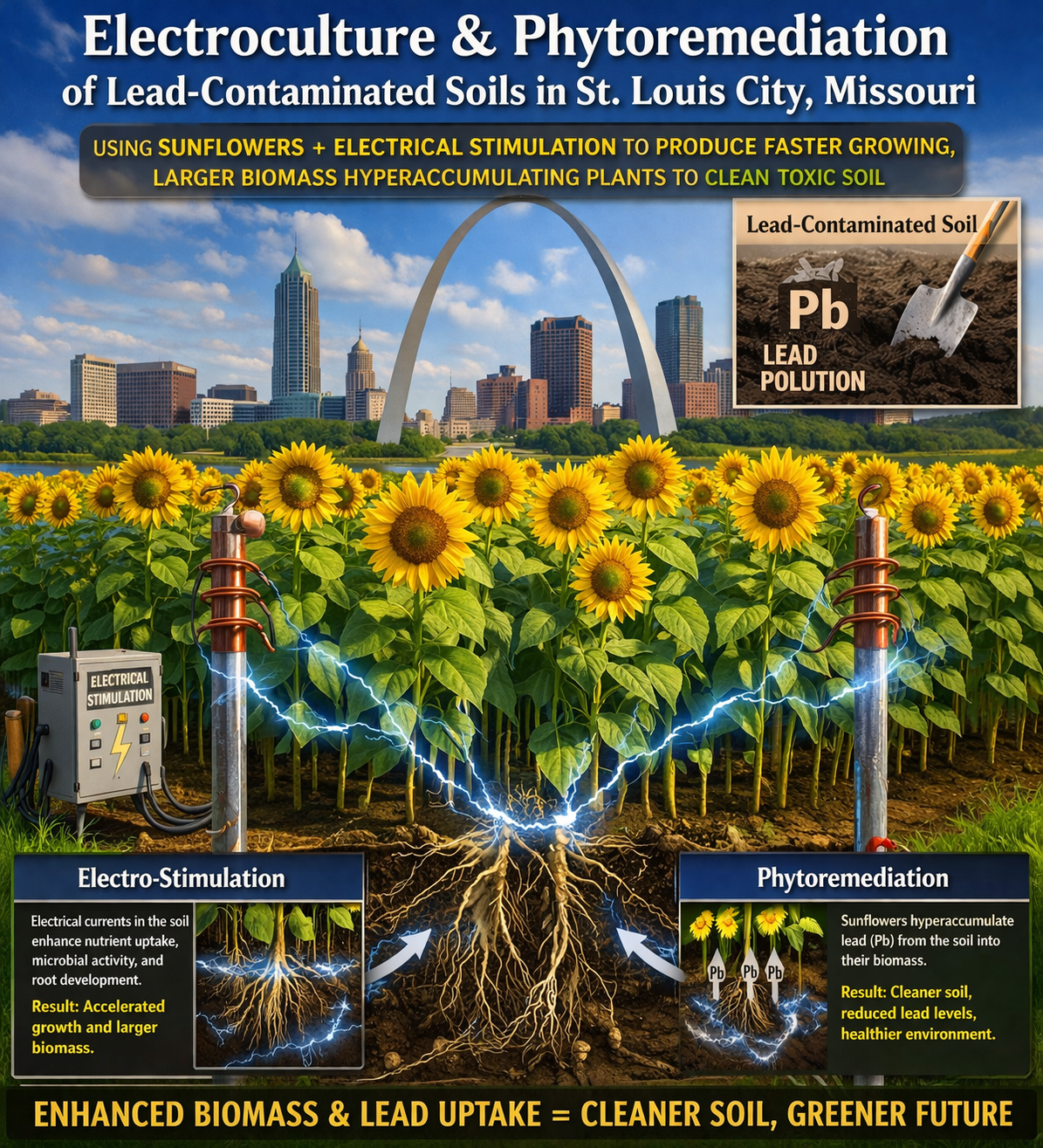
The Sunflower+ Project StL: Electrically-Accelerated Phytoremediation in the Field
A full season retrospective on our 2013 field experiment combining electroculture with phytoremediation on a vacant urban lot in St. Louis City — what we installed, how well we did and what it all means.
The Sunflower+ Project StL: Electrically-Accelerated Phytoremediation in the Field

In the spring of 2013, our team at Electric Fertilizer joined forces with the Sunflower+ Project StL — a citizen science and urban-agriculture initiative aimed at transforming a contaminated vacant lot in the Old North St. Louis neighborhood. What followed was a full growing season of electrode installations, unexpected plant growth patterns, wilted hopes, and one very memorable row of sunflowers that stood a full foot above everything else.
This is the complete retrospective. For a shorter, evidence-graded summary of the project — including independent third-party corroboration of the project and its outcome — see the Sunflower+ case study.
Background: The Problem With Urban Vacant Land
Across post-industrial American cities, vacant lots carry a hidden burden. Decades of heavy manufacturing, leaded paint, leaded gasoline exhaust, and run-off have left soils loaded with heavy metals — lead, arsenic, and cadmium among the most common and dangerous. Children playing on these lots, gardeners growing vegetables, or simply residents breathing the dust are all at risk.
Old North St. Louis was no exception. Like many historically industrial urban neighborhoods, vacant parcels sat dormant — too contaminated for safe reuse, too expensive for conventional remediation.
The conventional approaches to cleaning such land — pump-and-treat systems, soil excavation, chemical immobilization — are prohibitively expensive for community-scale projects. Something different was needed.
Two Technologies, One Synergy
Phytoremediation: Plants as Cleanup Machines
Phytoremediation is the use of living plants to extract, contain, or degrade contaminants from soil or water. Certain species — called hyperaccumulators — absorb heavy metals through their roots and concentrate them in above-ground biomass, which can then be harvested and disposed of as hazardous waste.
Helianthus annuus (the common sunflower) is among the most well-documented lead and heavy-metal accumulators. It has been used in cleanup efforts following Chernobyl and studied extensively for lead and arsenic uptake in contaminated urban soils. It’s also fast-growing, highly visible, and community-friendly — three qualities that make it ideal for a public demonstration project.
The catch: phytoremediation is slow. A single growing season removes only a fraction of contaminant load. Meaningful remediation can take 5–15+ seasons depending on contamination levels and plant biomass produced.
Electroculture: Electricity as a Growth Accelerator
Electroculture is the application of low-level electrical fields — typically low-voltages — to promote plant growth, germination, and metabolic activity. The practice dates from ancient times to the mid-1700s, with rigorous modern study spanning the 20th century.
Known effects documented in the literature include:
- Accelerated germination rates — seeds exposed to weak electric fields germinate faster and more uniformly1
- Increased root elongation and branching — greater root mass means greater soil contact and contaminant uptake2
- Enhanced microbial metabolism — soil microbes exposed to weak fields show increased activity, accelerating organic contaminant degradation3
- Greater biomass production — shoots and leaves grow larger, increasing both yield and the total volume of metal-laden tissue available for harvest
The hypothesis driving our involvement was straightforward: if electricity accelerates plant growth and microbial activity, it should also accelerate phytoremediation. A faster-growing sunflower with a deeper, denser root system should pull more lead from the ground per season than an unelectrified one.
Winning the Plot: The Sustainable Land Lab Competition
In late 2012, the City of St. Louis, the Old North St. Louis Restoration Group, and Washington University launched the Sustainable Land Lab Competition — a public design competition to find innovative, community-oriented uses for vacant urban lots. Teams competed for 2-year leases to a parcel of land in Old North.
The Sunflower+ Project StL team entered with a proposal to plant sunflowers for phytoremediation, land beautification, and community engagement. Electric Fertilizer joined the team late in the process, adding an electroculture component that would occupy roughly half the plot as an active test area against the other half as a control.
On April 14, 2013, we learned we had won — one of five finalists selected from a field of regional teams.
The posterboards submitted for the competition laid out our dual-purpose goals:
- Demonstrate that sunflowers positively respond to DC electric fields in soil (accelerated growth, greater biomass)
- Verify at season’s end that the electrified portion of the plot had removed greater amounts of lead from the soil than the unelectrified control
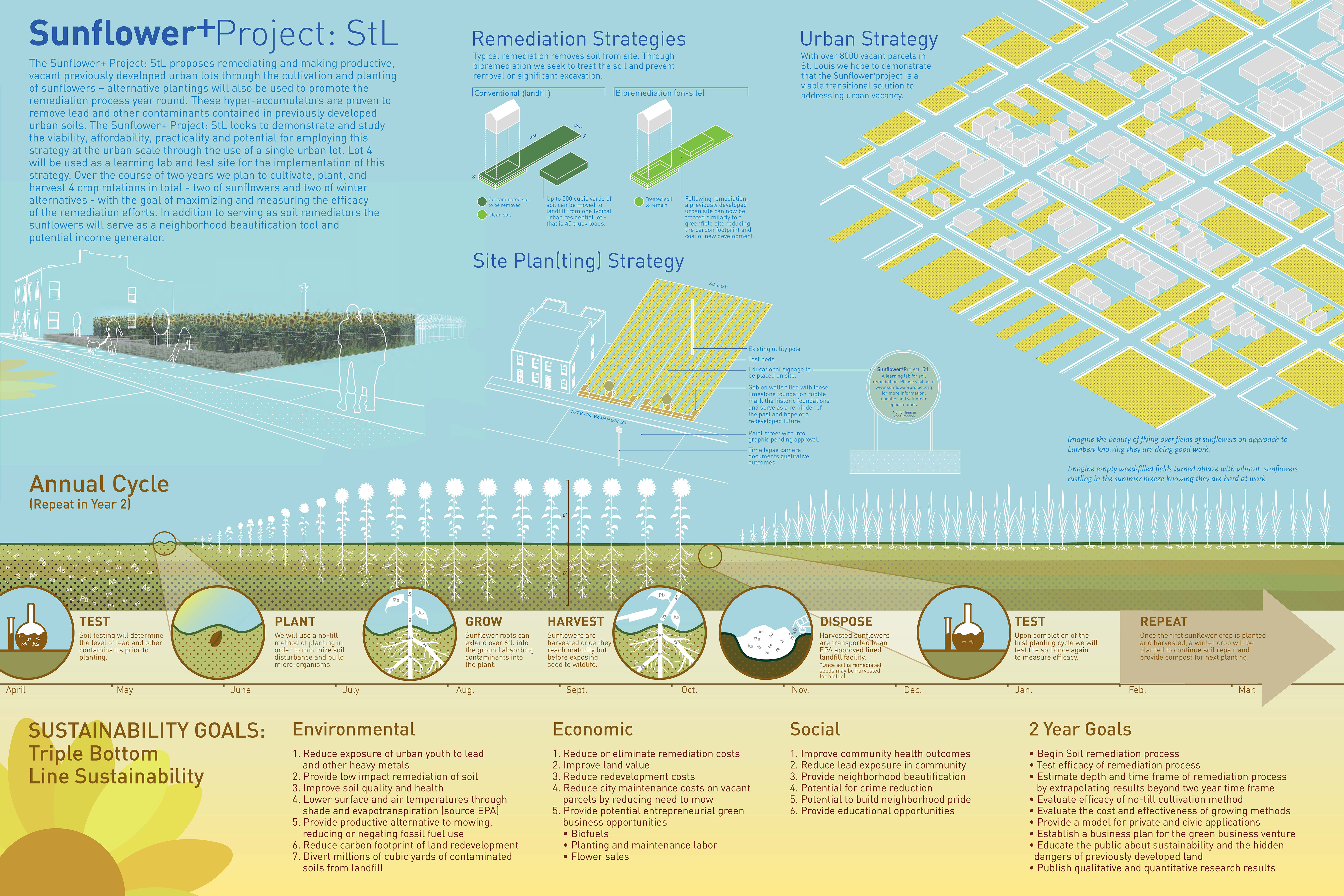
Tracking was to be accomplished via visual inspection (webcam), and by soil testing at the beginning and end of each growing phase.
Setting Up the Experiment
Planting Plan
Planting occurred in two phases with multiple propagation strategies:
| Date | Method | Location |
|---|---|---|
| April 27, 2013 | Greenhouse seedlings (Kraut Farms) | Off-site, transplanted later |
| May 18, 2013 | Transplanted seedlings | In-field |
| May 18, 2013 | Direct-sow, 1–2 seeds/hole | Just outside the electrified zone |
| May 18, 2013 | Direct-sow, 5–10 seeds/hole | ~15 feet from electrified zone |
The greenhouse start was a safety precaution: we weren’t yet certain whether the lot’s soil contamination levels would prevent germination, and we wanted to avoid losing everything to a late frost.
May 18th coincided with the Sustainable Land Lab Awards Ceremony — an apt moment to put seeds in the ground.
Electrode Installation
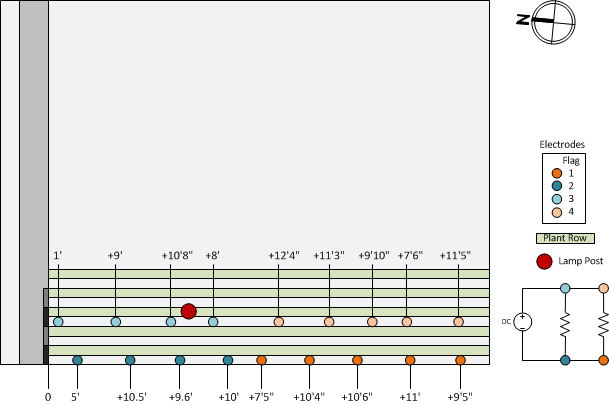
The day of the awards ceremony, our team arrived early to begin installing the electrodes — steel rods driven vertically into the ground across the test plot, wired in two sets of electrode rods soldered onto a multi-tap insulated wire, and later connected to a DC power supply running at 1.5–3 volts.
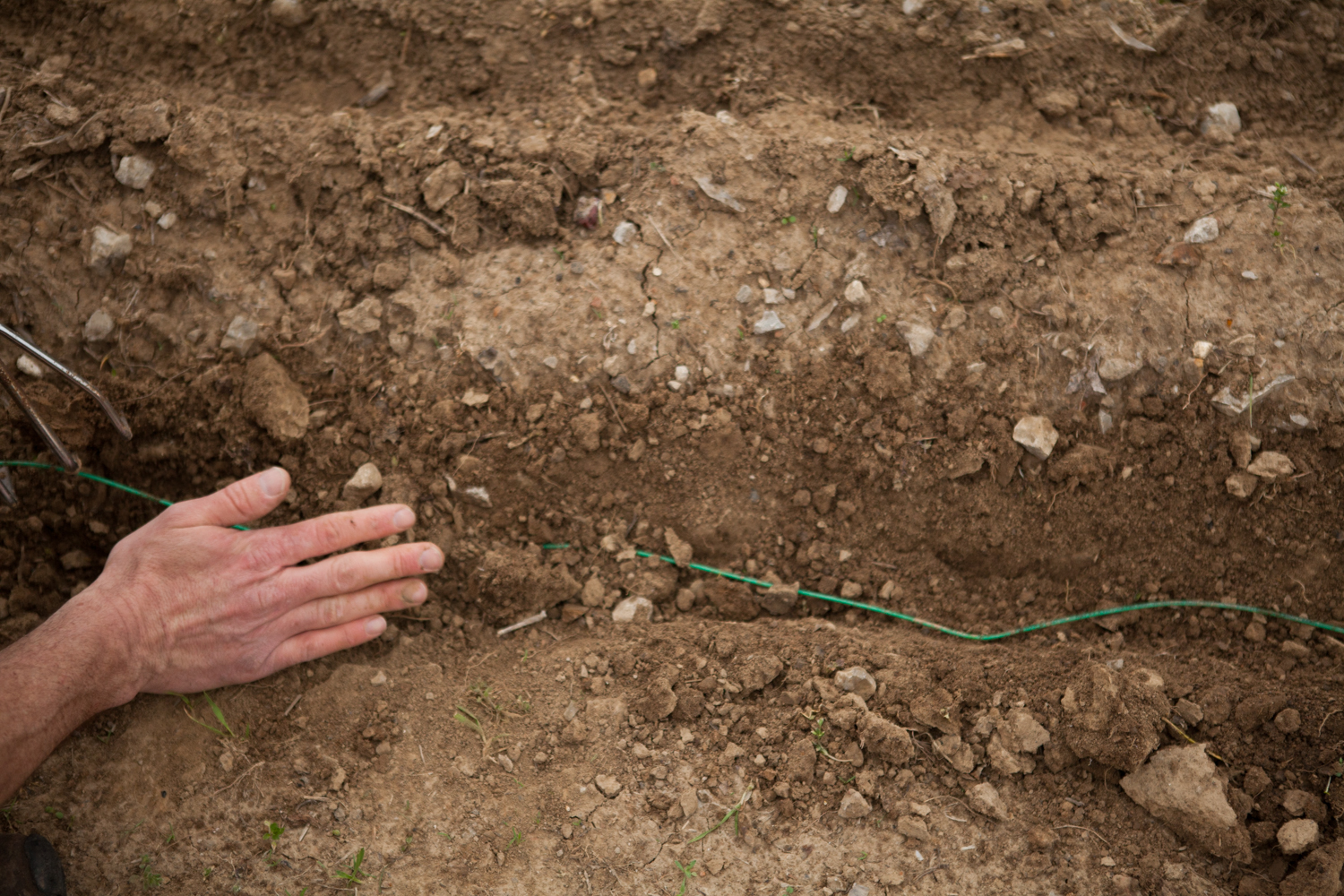
It was harder than anticipated. The soil was compacted and dry in many locations, requiring hours of effort to drive rods to sufficient depth. After approximately 5–6 hours of work, the system was in the ground.
A secondary microcontroller-driven region was also installed in the back-left of the plot — designed to deliver time-varying voltage patterns rather than a constant DC field — with its electronics sealed (or so we thought) in a buried enclosure.
The DC supply was initially a makeshift unit while a more sophisticated monitoring circuit was being developed.
First Success: July 27, 2013
Eight weeks after planting, we returned to the field for an observation visit. The results were striking.
What We Saw
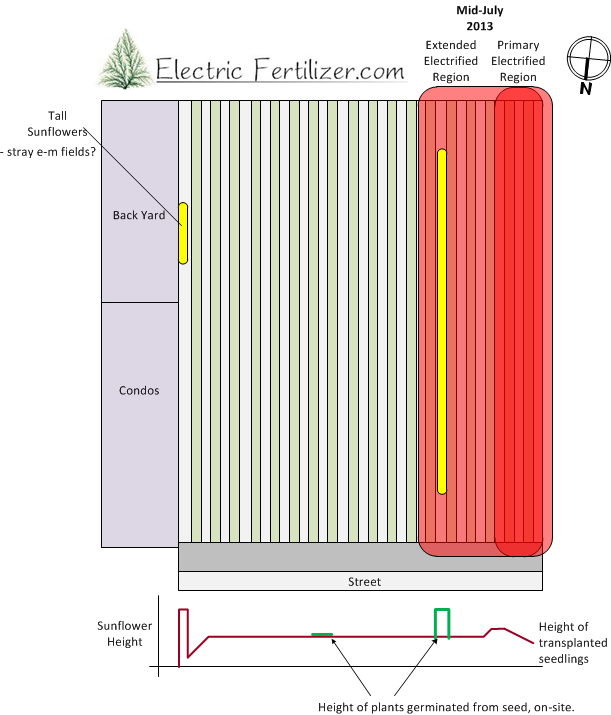
Upon arrival, one row of sunflowers stood nearly a full foot taller than every other plant in the field. The rest of the field had largely gone to seed, flowers wilted — but this one row remained in full, vigorous bloom.
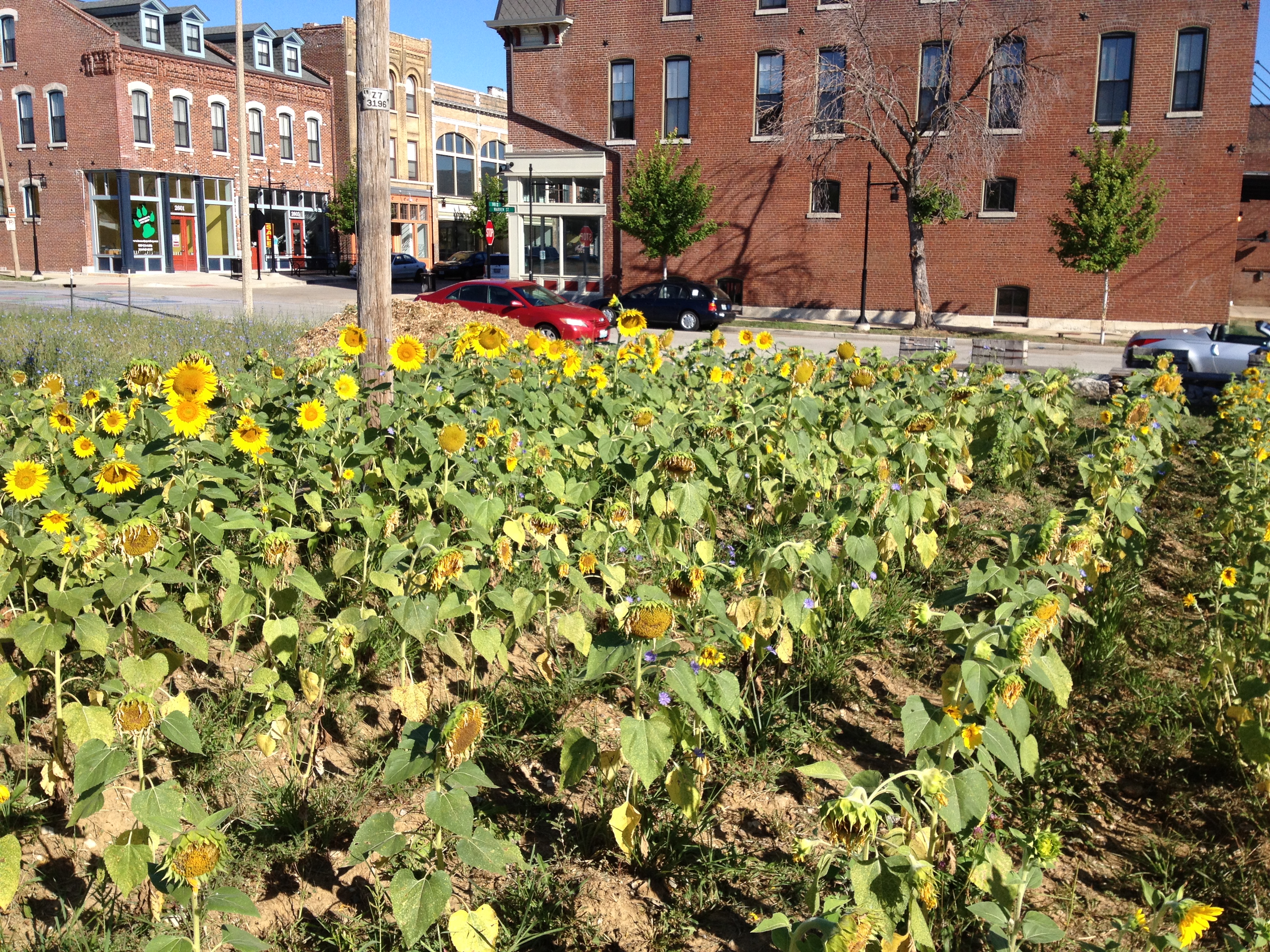
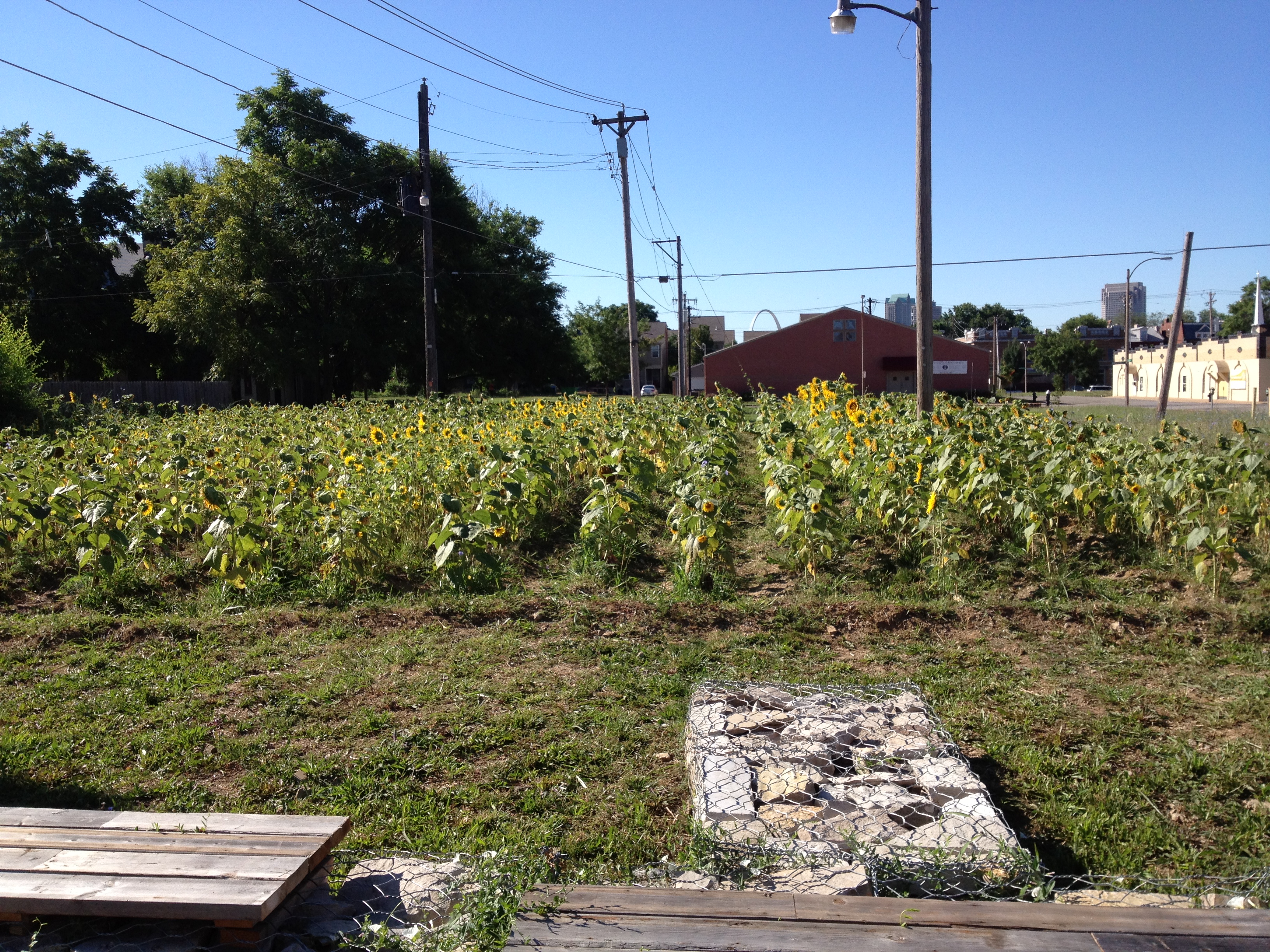
A second row, located approximately 15 feet from the electrified zone, was also flowering but thinner, with smaller blooms — consistent with higher plant density competing for resources.
Here’s a layout diagram that makes it easier to understand what we observed:
Untangling the Variables
The obvious interpretation — “electricity made them taller” — turned out to be more nuanced.
The tall row, on closer examination, was:
- Younger (directly-sowed seed, not transplanted seedling)
- From the same seed batch as the other plants
- Located within the electrified zone
That a younger cohort outgrew an older one from the same seed stock is counterintuitive in the absence of an intervention. Normally you’d expect older plants to be larger. This inversion is significant.
The Growth Gradient
Perhaps the most scientifically interesting finding was a height gradient observed across the electrified region:
- Plants nearest the positive electrodes were tallest
- Plants at increasing distance from the electrodes showed progressively less height advantage
- Plants at the far edge of the electrified zone showed minimal or no effect
This gradient is consistent with what we’d expect from an attenuating electric field — voltage drops across the resistive soil medium, so plants farther from the source receive weaker stimulation.
At 1.5–3V across the plot, the field strength at 15 feet was apparently below the threshold for significant growth stimulation. This raises an important design question for future experiments: what is the minimum effective field strength, and how does electrode spacing affect coverage?
Seeds vs. Seedlings
One of the more refined findings was the differential response between transplanted seedlings and directly-sowed seeds:
- Electrified seedlings showed minimal height advantage — suggesting that by the time they were transplanted, the window for maximum electrostimulation (germination and early root development) had passed
- Electrified seeds (directly sowed in the field under the electric field) showed measurable height gains, consistent with literature showing that seed electrostimulation at germination is the most impactful application window. There’s also a lot more research on this that can be found on our research pages.
This leads to a key hypothesis: the greatest growth benefit from electroculture occurs during germination, not vegetative growth. Future experiments should prioritize field-seeding over transplanting when electroculture is the goal.
Summary of Observed Effects
| Observation | Interpretation |
|---|---|
| Younger directly-sowed plants taller than older seedlings | Strong germination-phase electroculture effect |
| Height gradient from electrodes outward | Field strength attenuates with distance; 1.5–3V insufficient at 15 ft |
| Clustered plants (5–10/hole) not notably taller | Competition for resources offsets growth benefit |
| Leaf greenness equal across groups | No detectable effect on chlorophyll |
| Speckled leaves on all plants equally | No improvement in insect resistance at this voltage |
Note on insect resistance: All plants, electrified and control, showed leaf speckles indicative of insect feeding. Electroculture has been theorized to deter some pests via changes in plant volatile compounds4, but we observed no such effect at 1.5–3V.
Season 1 Postmortem: March 2014
When we returned to the Warren Street site in March 2014 — nearly a full year after installation — the electrodes had been in the ground continuously at 1.5–3V.
Electrode Corrosion
Removing the steel rods revealed dramatically varying degrees of corrosion across the positive electrodes. Some rods were nearly intact; others had corroded down by more than 2.5 inches of material into very sharp points.
The variation correlated with soil drainage and moisture:
- Rocky, compacted areas (front of plot): highest corrosion, likely because pooled rainwater sat against the rod base
- Well-draining soft soil: more moderate corrosion
- Rocky back section: similar to front
This variation has implications for system reliability and longevity. An electrode that corrodes away in a single season can lose electrical contact with the soil, creating dead zones in the field. For a multi-season phytoremediation project, corrosion-resistant electrode materials (graphite, titanium, or galvanized alternatives) would be needed.
The Waterlogged Electronics
The microcontroller enclosure in the back-left of the plot was not watertight. When opened, it contained standing water and severely rusted electronics — batteries, wiring, and the controller board all destroyed.
The intended sealed ports had not kept water out across a full year of precipitation.
Lesson learned: anything buried underground in a non-arid climate must be hermetically sealed, not just splash-resistant. The enclosure should have been rated for submersion or installed in an above-ground weatherproof housing with weatherproof cable penetrations below ground.
For the brief period the microcontroller did operate, the electrode degradation pattern it produced was visually distinct from the constant-DC electrodes — suggesting the time-varying voltage pattern had different electrochemical effects on the steel, a potentially interesting variable for future study.
What Did We Actually Learn?
Season 1 was simultaneously a success and a lesson in experimental design. Here’s an honest summary:
What Worked
- Electroculture at germination produced measurable, visible growth advantages in directly-sowed seeds under the electric field
- Field-scale electrode installation is feasible with a small team and basic tools, even in compacted urban soil
- Visual gradient analysis provided qualitative evidence consistent with electric field attenuation across the plot — a finding we didn’t anticipate
What Didn’t Work (As Planned)
- Transplanted seedlings showed minimal electroculture benefit — they missed the high-growth germination window
- 1.5–3V was too low to maintain effective field strength more than a few feet from the electrodes
- Electronics were not adequately weatherproofed for a buried, year-round deployment
- Soil testing at beginning and end of season (to measure actual lead removal) was not completed as planned — meaning we have no quantitative phytoremediation data from Season 1
The absence of soil lead data is the most significant gap. Without before/after measurements, we cannot claim the electroculture intervention accelerated lead uptake — only that it influenced growth rates.
The Core Hypothesis Remains Compelling
The mechanistic basis for electroculture-enhanced phytoremediation is grounded in well-documented biophysical phenomena:
- Increased root elongation under DC fields → greater soil volume explored per plant2
- Enhanced ion mobility in soil moisture → higher availability of heavy metal ions to root uptake mechanisms5
- Greater aboveground biomass → more tissue available for metal storage and eventual harvest
A properly designed follow-up experiment — with controlled voltage, corrosion-resistant electrodes, direct seeding throughout, and rigorous pre/post soil testing — could quantitatively test these mechanisms.
Electrically-Enhanced Remediation: The Bigger Picture
The Sunflower+ Project was a small-scale community demonstration, but the underlying technology it was testing addresses a very large problem.
The EPA estimates that millions of American homes, particularly in pre-1978 urban housing stock, sit on or near soil with elevated lead levels. Conventional remediation for a single urban lot can cost tens of thousands of dollars. Phytoremediation, by contrast, can be implemented by community members with seed packets and seasonal labor.
If electroculture can reliably accelerate phytoremediation — increasing per-season lead uptake by even 20–50% — the math on multi-year remediation timelines changes meaningfully. Fewer seasons needed means lower total cost, faster safe reuse, and more community buy-in.
The fundamental approach:
Contaminated lot
    + Sunflowers (or other hyperaccumulators)
    + Low-voltage DC electrode grid (1.5–12V depending on scale)
    + Pre/post soil testing
    = Potentially faster, community-accessible heavy metal removal
For anyone interested in implementing something similar:
- Test your soil first — contact your county extension office or use a certified lab to establish a baseline lead/arsenic/cadmium reading
- Choose your hyperaccumulator — sunflowers, Indian mustard (Brassica juncea), and alpine pennycress (Noccaea caerulescens) are well-studied options6
- Design for direct seeding — transplanting reduces the electroculture benefit; sow directly into the electrified zone
- Use corrosion-resistant electrodes — graphite rods or titanium-mesh anodes will last multiple seasons
- Weatherproof all electronics thoroughly — or keep them above-ground in locked weather-rated enclosures
- Retest soil at season’s end — this is how you build the evidence base
What’s Next
With the electrode system removed for tilling, and lessons from Season 1 in hand, we are planning improvements for Season 2 — a redesigned electrode array, direct-seeded plots, better soil testing protocols, and proper electronics enclosures.
The goal remains the same: demonstrate that communities can take contaminated vacant land and, with affordable technology and seasonal effort, reclaim it.
Last year there was an article on the 12th anniversary of the project.
References and Further Reading
External Resources
- EPA Citizens’ Guide to Phytoremediation
- EPA Citizens’ Guide to Bioremediation
- EPA: Lead in Soil
- Sunflower as a Lead Hyperaccumulator — Chernobyl Case Study
- Sustainable Land Lab Competition Overview
This article is part of an ongoing series on the Sunflower+ Project StL. For updates on Season 2 and our evolving electroculture systems, follow along on the blog or join the mailing list.
Footnotes
-
Pietruszewski, S., Kania, K. (2010). Effect of magnetic field on germination and yield of wheat. International Agrophysics, 24(3), 297–302. ↩
-
Guo, M., et al. (2019). Effects of electric field on plant growth and mineral nutrient uptake. Plant and Soil, 438, 239–255. doi:10.1007/s11104-019-04023-y ↩ ↩2
-
Lear, G., et al. (2004). The effect of electrokinetics on soil microbial communities. Soil Biology and Biochemistry, 36(11), 1751–1760. doi:10.1016/j.soilbio.2004.04.030 ↩
-
Maffei, M.E. (2014). Magnetic field effects on plant growth, development, and evolution. Frontiers in Plant Science, 5, 445. doi:10.3389/fpls.2014.00445 ↩
-
Acar, Y.B., Alshawabkeh, A.N. (1993). Principles of electrokinetic remediation. Environmental Science & Technology, 27(13), 2638–2647. doi:10.1021/es00049a002 ↩
-
Chaney, R.L., et al. (1997). Phytoremediation of soil metals. Current Opinion in Biotechnology, 8(3), 279–284. doi:10.1016/S0958-1669(97)80004-3 ↩
Continue Your Learning Journey
This article is part of a larger body of knowledge covering electroculture, atmospheric energy harvesting, soil enhancement, plant stimulation, and experimental growing systems.
Learn more inside Energetic Growers Academy.
Explore Courses