Potential Power of the Pyramidal Structure (Biosensor Detection)
Key Findings
- Cucumber biosensor (ethyl acetate gas from cut tissue) detected a statistically significant psi index (ΨE-CAL) at the pyramid apex, p < 0.01, compared to calibration point 8 meters away (zero effect).
- Effect was reproducible across 252 summer and 216 winter observations (2007–2019); summer effect was consistently larger than winter.
- Effect detected under strict 20-day human-free protocol, confirming the pyramid structure itself — not human biofield interaction — generates the signal.
- Faraday cage shielding eliminated EM field confounds; the residual biological effect persisted.
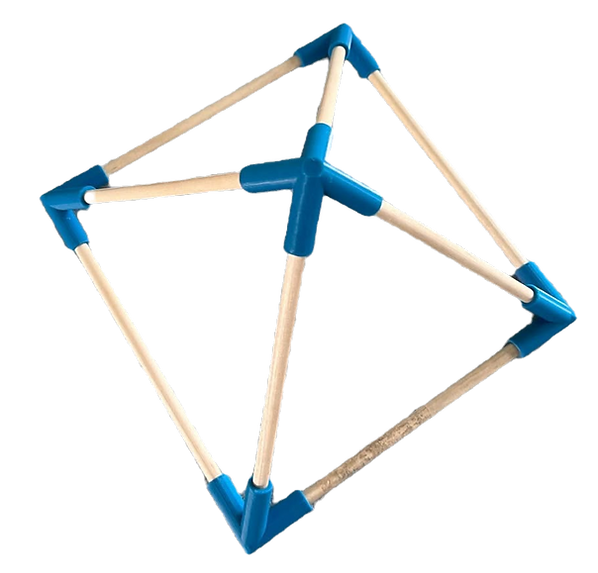
- Pyramid design: aluminum frame, 188cm × 188cm base, 107cm height (49.1° slope, not Great Pyramid proportions), polystyrene sides with 36 aluminum plates in Sierpinski triangle pattern.
Researchers at the International Research Institute (IRI) in Chiba, Japan used cut cucumber sections as biological gas-emission sensors to test whether a pyramid structure generates a detectable field effect in the absence of any human subjects. The biosensor principle: injured plant tissue releases ethyl acetate gas in proportion to metabolic activity; the rate varies with the orientation of the cut relative to the growth axis. The psi index (ΨE-CAL) is a log-ratio metric calibrated against ambient samples 8 meters away to eliminate temperature, humidity, and pressure effects.
The aluminum-frame pyramid (188cm × 188cm × 107cm, sides covered with Sierpinski-patterned polystyrene panels, not proportioned to the Great Pyramid) was tested across a dataset spanning 2007–2019 (468 total observations). Biosensor samples placed at the pyramid apex showed a statistically significant non-zero psi index at the 1% level. The effect was spatially specific — calibration samples 8 meters away showed no effect — and temporally consistent, with summer observations yielding higher effect magnitude than winter. The experiment was run under a 20-day strict human-exclusion protocol to rule out human biofield contributions documented in the group’s prior work.
Faraday cage shielding was used to eliminate electromagnetic field explanations; the biosensor response persisted.
Relevance to agricultural pyramid research: This paper does not measure plant growth. Its value is indirect: if a pyramid geometry generates a reproducible biological field effect detectable by plant tissue (even as a gas-emission metric), this supports the general hypothesis that pyramid enclosures can influence seed or microbial metabolism — as reported in Kumar 2005 (antimicrobial) and Kumar 2011 (germination). However, the pyramid used here is structurally quite different from the solid plywood/fiberglass models in agricultural studies, so direct extrapolation is not warranted.
Source: Takagi O, Sakamoto M, Yoichi H, Kawano K, Yamamoto M. Natural Science 11(8) (2019), pp. 257–266. DOI: 10.4236/ns.2019.118026.