Paramagnetic Root-Zone Enhancement: Working With Earth's Magnetic Environment
Phil Callahan's discovery that good soil is paramagnetic soil opened a new way of thinking about how Earth's ambient magnetic field shapes plant growth. Here's what the science says, what remains under investigation, and how paramagnetic devices fit into that picture.
On scientific honesty: Paramagnetic root-zone enhancement sits at the intersection of established geophysics, soil science, and a framework — the Environmental Nexus System — that is our own working model, not peer-reviewed consensus. This article distinguishes carefully between what is documented, what is mechanistically plausible, and what remains experimental.
Paramagnetic Root-Zone Enhancement
Plants don’t grow in a sensory vacuum. Every living root system is immersed in Earth’s geomagnetic field, atmospheric electric fields, solar-driven electromagnetic fluctuations, and the weak electromagnetic oscillations generated by global lightning activity — the Schumann resonances. These fields don’t get listed on a soil test or a fertilizer bag. But the organisms that have been growing in that environment for hundreds of millions of years may have evolved to use them.
Paramagnetic root-zone enhancement starts from a simple idea: if some materials weakly amplify ambient magnetic fields rather than ignoring them, placing such materials in the root zone might create a slightly different electromagnetic environment around growing roots — one that more closely resembles what plants evolved in, in naturally rich soils.
The idea is not new. It traces back to a USDA entomologist who spent decades measuring soils around the world and noticed that productive soils are magnetically different from depleted ones.
Phil Callahan and the Paramagnetic Soil Discovery
Dr. Phil Callahan spent his career studying the biophysics of insects and later soil. Using sensitive magnetometers, he measured the magnetic susceptibility of soils across agricultural regions and made a consistent observation: good agricultural soil is paramagnetic; depleted or unproductive soil tends toward diamagnetic or magnetically neutral.
Paramagnetic materials have a positive magnetic susceptibility — they are weakly attracted to magnetic fields and slightly amplify local ambient field strength. This is the opposite of diamagnetic materials (copper, water, most plastics), which weakly repel magnetic fields. Most volcanic rocks — basalt especially — have measurable paramagnetic susceptibility because of their iron oxide mineral content.
Callahan’s central claim: soil that has been repeatedly cropped, chemically fertilized, or compacted loses paramagnetic minerals over time, and this loss may be one underappreciated dimension of declining soil health. His remediation suggestion was correspondingly simple: add paramagnetic rock dust (basalt is the most practical source) to depleted soils to restore a portion of the natural magnetic environment.
This connection — paramagnetic susceptibility as a measurable soil quality metric — is the most empirically grounded part of this story. You can measure it with a sensitive scale and a magnet. Soils genuinely differ in this property, and Callahan’s field observations (not double-blind trials, but extensive geographic surveys) consistently found the correlation with productivity.
What Paramagnetism Actually Is
Paramagnetism is a weak, non-permanent magnetic property of certain materials. Unlike iron or steel, paramagnetic materials don’t hold a charge. They respond to an external magnetic field while that field is present, and return to neutral when it’s removed.
| Material | Magnetic character | Agricultural relevance |
|---|---|---|
| Basalt (volcanic) | Paramagnetic (moderate-high) | Primary rock dust amendment |
| Iron oxides (FeO, Fe₂O₃) | Strongly paramagnetic | Found in high-χm basalt; key active mineral |
| Aluminum | Weakly paramagnetic | Common structural material |
| Copper | Diamagnetic | Repels field; antenna uses; avoid for paramagnetic applications |
| Water | Weakly diamagnetic | Relevant for magnetized water effects |
| Clay minerals | Variable | High-iron clays can be paramagnetic |
The key parameter is magnetic susceptibility (χm) — a dimensionless number describing how strongly a material responds per unit of applied field. Iron oxide sits around χm = 720; basalt varies by quarry source, but typically measures meaningfully above ambient soil. The practical implication: a basalt structure in an ambient geomagnetic environment doesn’t generate a new magnetic field, but it does slightly concentrate the existing one in its vicinity.
The Irish Round Tower Connection: Geometry Matters
Callahan’s research went one step further. Studying Irish round towers — the tall stone structures found across the Irish countryside, long assumed to be defensive or monastic architecture — he found that they were built from high-paramagnetic stone (often basalt or basalt-rich composites) and consistently located near agricultural land.
His hypothesis: round towers functioned as passive paramagnetic amplifiers. Their geometry concentrates Earth’s ambient magnetic field, and their placement near cropland may have been deliberate — by farming communities who had empirically learned, over generations, that crops near these structures did better.
The structural angle matters here. Callahan found that cone and tower shapes at approximately 51° — the same slope angle as Irish round towers, and interestingly, the same as the Great Pyramid of Giza — concentrate geomagnetic flux at the apex more effectively than other geometries. This is analogous to how a lens concentrates light: not by adding energy, but by redirecting it.
This geometric effect is the design basis for paramagnetic cone devices.
Visualizing Field Concentration
The following diagram illustrates the difference between ambient geomagnetic field lines (undisturbed) and the same field lines passing through a paramagnetic structure. The cone doesn’t add magnetic energy — it slightly redirects ambient flux toward its apex and base, concentrating the local field in the immediate surrounding zone.
Important note: The field concentration effect in paramagnetic materials at ambient geomagnetic field strengths (25–65 µT) is very small — on the order of parts per million. Direct measurement with a consumer-grade magnetometer will not detect it. The diagram illustrates the physical principle, not a measurable amplitude difference.
Earth’s Electromagnetic Background: What Plants Are Immersed In
The ambient geomagnetic field is only one layer of Earth’s electromagnetic environment. Plants in a natural, undisturbed setting also experience:
- Schumann resonances — standing electromagnetic waves between Earth’s surface and the ionosphere, generated continuously by global lightning. The fundamental frequency is 7.83 Hz; harmonics at 14.3, 20.8, 27.3, and 33.8 Hz. These are weak but continuous.
- Atmospheric electric field — approximately 100-150 V/m at the surface in fair weather, downward-directed, maintained by global lightning as a DC source. This field modulates plant transpiration, root ion transport, and microbial activity.
- Geomagnetic daily variation — Earth’s field varies by ~50 nT over a 24-hour cycle as the ionosphere interacts with solar wind. This is a small but consistent oscillation that biological systems may track.
- Solar activity cycles — longer-period variations in Earth’s field intensity tied to the 11-year solar cycle and shorter-term solar events.
The cumulative electromagnetic environment a plant experiences across its lifecycle is not static. It oscillates on daily, seasonal, and decadal timescales.
The Environmental Nexus System (ENS) Framework
The Environmental Nexus System is our working model for how these factors interact. Rather than treating each environmental input as independent, ENS proposes that plant health is an emergent property of multiple interacting energy systems.
ENS is our working framework, not peer-reviewed consensus. It is useful because it suggests that interventions like paramagnetic soil treatment are not standalone “treatments” but modifications to one input within a connected system — and that their effects may be conditional on the state of other inputs (soil biology, water availability, ambient electromagnetic environment).
This framing also suggests why results from paramagnetic amendments tend to be variable: the same device deployed in electromagnetically quiet, minerally rich soil with good water management may perform differently than in depleted, dry soil under dense urban RF interference.
Proposed Mechanisms in the Root Zone
The following mechanisms have varying degrees of support in the literature:
1. Local Magnetic Flux Concentration
A paramagnetic material placed in the ambient geomagnetic field slightly increases local field density in the region immediately surrounding it — most pronounced at the apex (tip) and base. The effect is proportional to the material’s magnetic susceptibility and the geometry of the structure.
Status: Physically established. The magnitude at ambient geomagnetic field strengths (~50 µT) is very small and not directly measurable by consumer instruments. Whether this magnitude is biologically meaningful is the open question.
2. Passive Coupling to Temporal Geomagnetic Variations
Earth’s magnetic field is not static — it oscillates daily by roughly 50 nT, has higher-frequency components tied to solar activity, and is modulated by Schumann resonance oscillations in the ionosphere-Earth cavity. A paramagnetic structure sitting in this oscillating field responds continuously to those variations. Whether this constitutes meaningful biological coupling is unknown.
Status: The geomagnetic variations are documented. Biological sensitivity to them is plausible but not established for most plants.
3. Influence on Ion Transport in Soil Water
Root nutrient uptake depends on ion mobility through soil water. Magnetic fields can affect the movement of charged particles under certain conditions (the Lorentz force). At ambient geomagnetic strengths, this effect on soil ion transport is theoretically very small. At the higher field strengths used in magnetized water research (100-650 mT), measurable effects on hydrogen bonding structure and ion mobility have been documented — but those field strengths are orders of magnitude above what a paramagnetic cone produces passively.
Status: Plausible mechanism at scale, but the dose-response at ambient paramagnetic field strengths is not established.
4. Rhizosphere Microbiology
Soil microbes are sensitive to their electromagnetic environment. DC electroculture studies have shown order-of-magnitude shifts in fungal and bacterial populations in response to applied electric fields (see Electric and Magnetic Field Stimulation as a Soil Amendment). Whether the far weaker field modifications produced by paramagnetic materials produce detectable microbial shifts has not been studied directly.
Status: Active research area in higher-field electrostimulation contexts; unexplored specifically for passive paramagnetic devices.
What We Know vs. What We’re Investigating
| Area | Status | Evidence quality |
|---|---|---|
| Paramagnetic materials concentrate ambient magnetic flux | Established — basic physics | Strong |
| Good productive soils tend to be paramagnetic | Callahan’s field observations | Moderate (observational, not controlled trials) |
| Basalt powder improves soil microbial activity and root development | Documented across multiple studies | Moderate |
| Static magnetic fields (100+ mT) affect plant growth, germination, enzyme activity | Documented | Moderate-Strong |
| Schumann resonances are biologically detectable | Documented in animals; plausible in plants | Emerging |
| Passive paramagnetic cone devices modify local flux measurably | Not confirmed at consumer magnetometer resolution | Not established |
| Passive paramagnetic cones produce plant growth effects | Grower observations; no controlled trials | Weak (anecdotal) |
| ENS as a predictive framework | Working model | Conceptual |
The honest position: the foundational physics is sound, the soil-paramagnetism-productivity link is observationally supported, and the adjacent research on magnetic fields and plant biology is robust. The specific step from a passive paramagnetic stone device to a measurable growth outcome has not been validated in controlled conditions. Growers who use these devices report consistent positive observations — we take that seriously, while recognizing it as a different epistemic category than a randomized trial.
Practical Considerations
Placement: Root-zone placement — at or just below soil surface, within the active rhizosphere — is the primary target based on the field concentration rationale. In container growing, placement at the substrate surface directly above the root ball is typical.
Orientation: The apex (tip) upward is conventional for cone devices, consistent with the field-concentration principle. The base of the cone sits at soil level; the apex is exposed.
Complement, don’t replace: Callahan’s own recommendation for depleted soils was basalt rock dust broadcast application — a volumetric paramagnetic amendment — as a first step, before structural devices. A paramagnetic cone in iron-poor, organically depleted soil is modifying an already-compromised environment. Addressing baseline soil health (organic matter, microbial diversity, mineral balance) first is likely to produce better outcomes than relying on a passive device in poor soil.
Combination with active electroculture: There is no known interference between passive paramagnetic devices and active electroculture setups (atmospheric antennas, DC earth batteries, magnetized water systems). ENS framing suggests these are complementary layers addressing different aspects of the plant’s electromagnetic environment.
The TerraNode Core: Design and Use
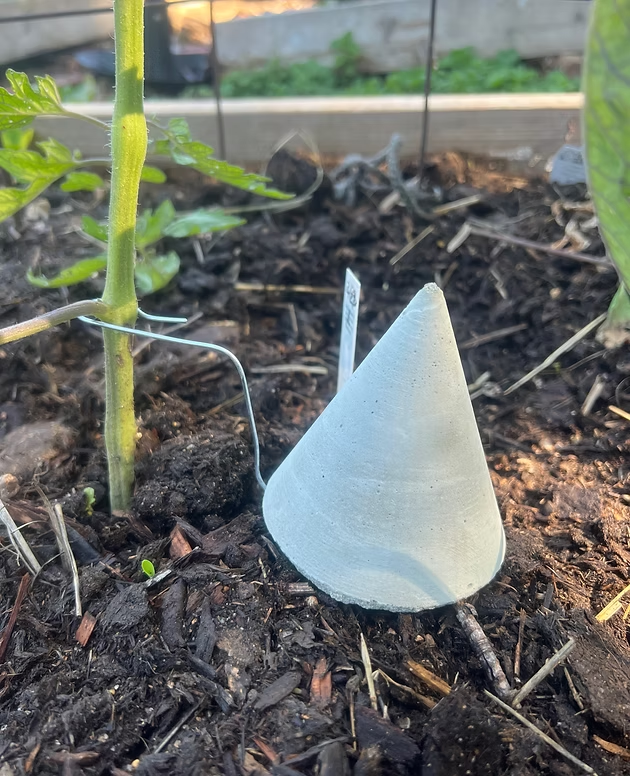
The TerraNode Core paramagnetic cone is cast from basalt with a 51° slope angle — the same geometry Phil Callahan identified in his Irish round tower analysis. It is a passive, maintenance-free device with no power supply, no consumables, and an indefinite service life.
Each cone includes an optional expansion wire that extends the magnetic influence along a row — useful for raised beds and row crops where a single cone would cover a limited radius.
Reported by growers using the TerraNode Core:
- Increased budding and early fruit set
- Improved root vigor and mass
- Better frost and drought resilience
- Enhanced soil activity near the device
These are grower observations, not controlled trial results. We present them with that qualification — and with the full mechanism discussion above — because we think you deserve to understand what you’re buying and why it may or may not work for your situation.
If you’re running your own experiments, we’d genuinely like to hear your results.
Ready to experiment with root-zone enhancement?
The TerraNode Core is available individually or in sets. Each cone is hand-cast from paramagnetic basalt at the 51° geometry, and includes an optional expansion wire for row applications.
For a deeper dive into the broader science of electric and magnetic stimulation in agriculture, explore the research section or read the full ENS framework overview.
References: Callahan, P.S. (1995). Paramagnetism: Rediscovering Nature’s Secret Force of Growth. Acres USA. | Callahan, P.S. (2001). Ancient Mysteries, Modern Visions: The Magnetic Life of Agriculture. Acres USA. | For magnetic field effects on plant growth: see Zhang et al. (2025) ACS Agricultural Science and Technology (EMF review) and associated studies in the research database.
Continue Your Learning Journey
This article is part of a larger body of knowledge covering electroculture, atmospheric energy harvesting, soil enhancement, plant stimulation, and experimental growing systems.
Learn more inside Energetic Growers Academy.
Explore Courses