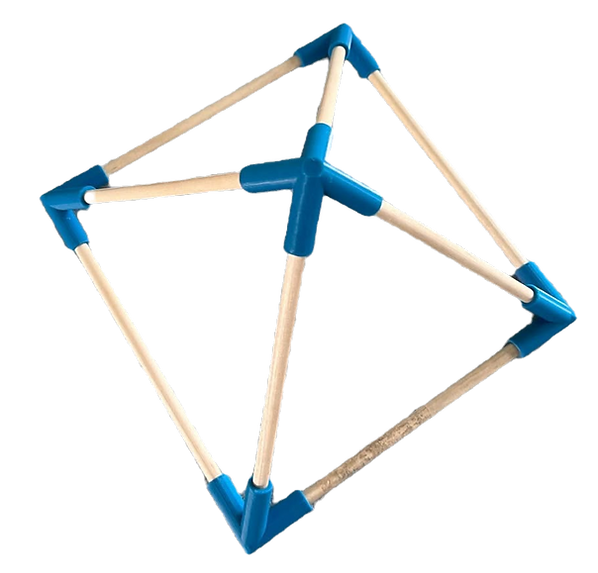
Placing seeds inside a pyramid-shaped enclosure during germination accelerates radicle emergence and seedling vigor.
A plywood square pyramid enclosure produced a 32% increase in fenugreek radical length at day 2 and a 15% increase in seedling vigor at day 4 versus open-air control, with statistically significant results (p<0.001). The effect correlates strongly with a 5°C interior temperature advantage over the control — suggesting the pyramid acts primarily as an insulated warm-microclimate chamber rather than through any geometric energy effect.
Rated low because the plywood pyramid maintained a +5°C temperature advantage over the open-air control throughout the trial (31°C vs. 26°C). Temperature was not controlled as an independent variable — no matched warm-box control was included. The germination acceleration is statistically real, but is most likely explained by thermal metabolic effects rather than pyramid geometry.
A plywood square pyramid (315mm × 200mm, oriented N-S) used as a germination enclosure produced significant improvements in fenugreek (Trigonella foenum-graecum) emergence compared to open-air control: radical length increased +32% by day 2 (1.03→1.36 cm, p<0.001), seedling vigor grew +15.2% by day 4 (7.02→8.09 cm, p<0.001), and fresh/dry weights rose ~14–16%. Emergence rate improved by 4 percentage points (92%→95–97%).
A fiberglass pyramid of identical dimensions produced non-significant radical length results at day 2 and only a marginal seedling vigor improvement at day 4 (p=0.040), suggesting the material matters more than the geometric shape.
Confidence is rated low because the plywood pyramid ran +5°C warmer than the open-air control throughout the trial (31°C vs. 26°C), and no temperature-matched control was included. Fenugreek germination is sensitive to temperature in this range; the thermal advantage alone is a sufficient explanation for the observed acceleration. Until the pyramid-geometry effect is tested against an equivalently warm non-pyramid enclosure, it is not possible to attribute the result to the pyramid shape specifically.
The practical upshot: an insulated enclosure at ~30°C is likely the operative variable, not the pyramid geometry. This is consistent with the fiberglass pyramid’s weaker effect — its transparency allows more heat loss, reducing the temperature differential.
Source: Kumar & Nagendra, Research Journal of Agricultural Sciences 2(3) (2011), pp. 629–631.